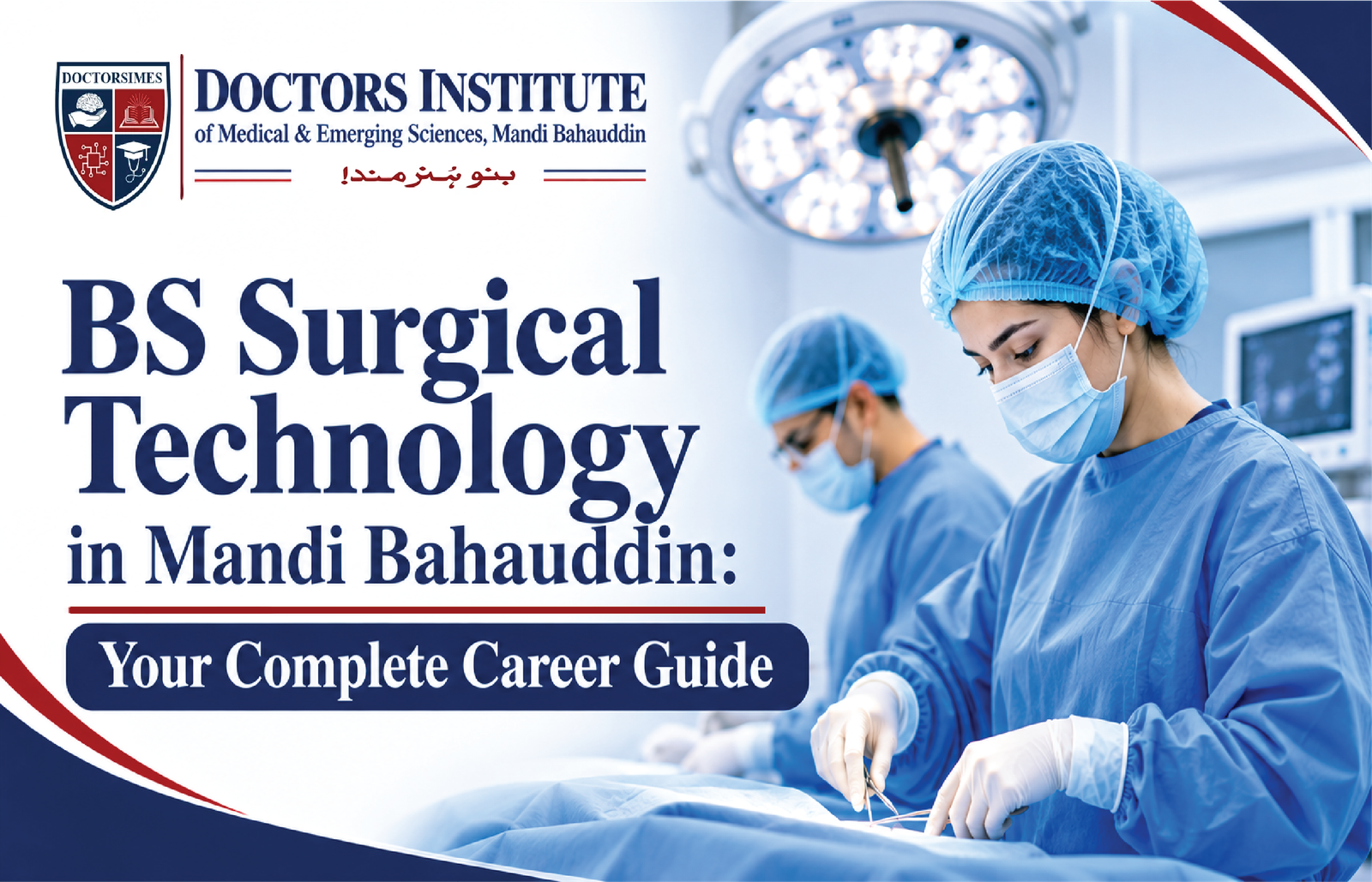
It is 2 a.m. An emergency case arrives. The surgeon scrubs in. The anaesthetist checks the monitors. One person has already arranged every instrument on the sterile tray, in the exact order the surgeon will need. That person is the surgical technologist.
Most patients never learn this professional’s name. Every surgeon knows it.
Pakistan’s hospitals perform more operations each year. Private surgical centres keep opening. Many operation theatres still struggle to find trained staff. This gap creates a real opportunity for young people who want a respected healthcare career without spending a decade in medical school.
BS Surgical Technology in Mandi Bahauddin offers that opportunity close to home. This guide covers the degree, the entry rules, the subjects, the training, the jobs, and the pay. Read it before you choose.
What Surgical Technology Actually Means
Surgical technology belongs to the allied health sciences. The discipline prepares students to work inside the operation theatre. The Association of Surgical Technologists defines the role as a member of the surgical team who protects patient care during an operation.
Hospitals use several titles for the same profession. You will hear operation theatre technologist, OT technician, scrub technologist, and circulating technologist. Each name points to a shared skill set.
The role has clear limits. A technologist does not diagnose disease. A technologist does not perform the operation. The technologist builds the safe, sterile, well-organised environment in which the surgeon works.
A day inside the theatre
The work follows three stages.
Before the operation. The technologist cleans the theatre and tests the equipment. Suction units, surgical lights, and diathermy machines all receive a check. Sterile packs get inspected. Every instrument set gets counted.
During the operation. The scrub technologist stands beside the surgeon. They pass instruments before the surgeon asks. They prepare sutures, swabs, and dressings. Their eyes never leave the sterile field.
After the operation. The team recounts every instrument and swab. The technologist clears the room. Used instruments travel to the sterilisation unit. The theatre resets for the next patient.
Why Mandi Bahauddin Is a Smart Place to Study
Mandi Bahauddin serves a large agricultural district. Families from many villages travel to the city for medical care. Local hospitals treat road accidents, obstetric emergencies, and routine surgical cases every day.
This pressure creates steady demand for theatre staff. A graduate who knows the local health system can start contributing from the first week.
Studying in your home city saves money. Hostel rent disappears. Daily travel costs shrink. Family support stays within reach during demanding semesters. Clinical rotations at nearby hospitals also cut commuting time.
Review the current degree list on the doctorsimes programs. Confirm seat numbers, fees, and the exact programme title before you apply.
BS Surgical Technology Eligibility and Admission
Each institute sets its own rules. Most Pakistani universities follow a common pattern for allied health degrees.
Usual eligibility criteria
Applicants normally need an intermediate certificate with a pre-medical background. Some institutes accept other science combinations with strong biology marks. Minimum percentages change from year to year, so check the latest prospectus.
Theatre work demands good vision, steady hands, and the stamina to stand for hours. Some institutes therefore request a medical fitness certificate.
Admission process
- Read the official admission notice.
- Gather your documents: matric and intermediate result cards, CNIC or B-form, domicile, and photographs.
- Complete the application form.
- Pay the processing fee.
- Sit the entry test or interview if required.
- Check the merit list.
- Submit the admission fee before the deadline.
Always verify recognition before you pay. The Higher Education Commission publishes information about recognised institutions. A degree without proper recognition limits your options later.
Contact the admissions office for current deadlines and requirements.
Degree Structure and Duration
Most BS programmes in allied health run for four years across eight semesters. The early semesters build a base in medical science. The later semesters shift toward surgical practice. A hospital internship usually completes the degree.
Credit hours and exam formats differ between institutes. Ask for the full scheme of studies during admission.
Subjects You Will Study
The curriculum pairs lecture-based theory with practical lab work.
Anatomy and physiology. These subjects teach how the human body works. Students learn the position of organs, the structure of muscles, and the route of blood vessels.
Biochemistry and pathology. Biochemistry explains the chemical processes behind healing. Pathology shows how disease changes tissue.
Microbiology and infection control. This area forms the backbone of the profession. Students study bacteria, viruses, and fungi. They learn how infections move through a hospital. They practise sterilisation, disinfection, and safe waste disposal.
Pharmacology and anaesthesia basics. Technologists need to recognise common surgical drugs. They also learn the equipment their anaesthetic colleagues use.
Surgical instruments and procedures. Students memorise the names, shapes, and uses of hundreds of instruments. Modules cover general surgery, orthopaedics, gynaecology, ENT, urology, and ophthalmology. Each module explains setup, patient positioning, and instrument choice.
Patient safety. Courses address consent, pressure injury prevention, and emergency response. The World Health Organization promotes a Surgical Safety Checklist that theatre teams worldwide use to prevent avoidable errors.
Ethics and communication. Students practise confidentiality, respect, and teamwork. Employers value these habits as highly as technical skill.
Research methods. Many programmes require a short research project. Students collect data, write a report, and present their findings.
Skills That Separate Good Technologists from Great Ones
Knowledge gets you hired. Character builds your reputation.
Precision. One missed swab can harm a patient. Strong technologists count, check, and count again.
Composure. Emergency cases arrive without notice. A steady mind keeps the whole team focused.
Physical stamina. Some operations last many hours. Technologists stand, lift, and move at speed.
Clear communication. A surgeon may ask for an instrument in one word. The technologist must respond instantly.
Honesty. A breach in sterility must be reported at once. Concealing it puts a life at risk.
Clinical Training: Where Theory Becomes Skill
A classroom cannot replace a real theatre. Strong programmes send students into hospitals early.
Students begin as observers. They watch experienced technologists, nurses, and surgeons. Next they assist with room setup and cleaning. In the later years they scrub in under close supervision.
Skill labs give students a safe place to practise. They rehearse gowning, gloving, draping, and instrument handling on training models. Repetition turns each action into habit.
The final internship brings full-shift responsibility. Interns rotate through several surgical units. Hospitals often offer jobs to interns who impress them.
Ask three questions when you compare institutes. Which hospitals host the rotations? How many students share each placement? Who supervises the interns?
Career Scope After BS Surgical Technology
The scope of BS Surgical Technology in Pakistan keeps growing. Every surgical specialty needs trained theatre staff.
Where graduates work
- Public sector hospitals, recruited through provincial health departments
- Teaching hospitals with large surgical units
- Private hospitals and day-care surgical centres
- Military and charity hospitals
- Specialised centres for cardiac, neurological, orthopaedic, or eye surgery
Common job titles
- Surgical technologist
- Operation theatre technologist
- Scrub technologist
- Circulating technologist
- Sterile services supervisor
- Surgical equipment specialist
- Clinical instructor
Paths beyond the theatre
Experienced graduates can teach. Colleges need instructors who understand both theory and practice.
Medical device companies hire people who know surgical equipment. Training and product support roles suit them well.
Higher study is another route. An MS or MPhil in an allied health subject leads to senior hospital roles and university posts.
Some graduates move into hospital management after adding administrative qualifications.
Explore related health programs on the Doctorsimes to compare career options before you decide.
Surgical Technologist Salary in Pakistan
Pay varies by employer, city, and experience. Public sector posts follow government pay scales. Private hospitals set their own rates. Big city hospitals generally pay more than small town clinics.
Fresh graduates start at a modest level. Income rises with experience, specialty skills, and extra training. Overtime and emergency duties raise monthly earnings in many hospitals.
Check current job advertisements for accurate figures. Salary data changes quickly. A number in any guide can age within months.
Working Abroad
Gulf countries recruit healthcare technicians from Pakistan. Hospitals in Saudi Arabia, the UAE, and Qatar advertise theatre vacancies regularly. Requirements differ by country.
Most employers ask for a recognised degree. Many want at least two years of experience. Some demand a local licensing exam.
The United States uses a certification exam run by the National Board of Surgical Technology and Surgical Assisting. Details appear on the NBSTSA website. Foreign graduates must read the eligibility rules carefully, since pathways vary.
Plan early if overseas work appeals to you. Build experience at home. Sharpen your English. Keep your documents in order.
How to Choose the Right Institute
A degree carries only as much weight as the institute behind it. Use this checklist.
- Recognition: Confirm approval from the HEC or the relevant regulator.
- Faculty: Look for teachers with hospital experience.
- Facilities: Ask about skill labs, models, and sterilisation units.
- Hospital partnerships: Strong links improve clinical exposure.
- Student support: Good institutes offer advising and internship placement.
- Fee transparency: Request a written fee structure.
Visit the campus. Meet current students. Their honest answers reveal more than any brochure.
Learn more about the institute on the Doctorsimes homepage.
Frequently Asked Questions
What is the scope of BS surgical technology?
A Bachelor of Science (BS) in Surgical Technology (also referred to as Operation Theatre Technology or OTT) is a 4-year undergraduate allied health sciences degree. It prepares professionals who are vital members of the surgical team.
What can I do after BS surgical technology?
You can work directly in operating rooms, move into specialized medical fields, or transition into management, education, and industry roles.
What is the scope of a surgical technologist in Pakistan?
The scope of a surgical technologist in Pakistan spans clinical care, operating room management, medical device industries, and higher education.
How long does the degree take?
Most institutes run a four-year programme. A final internship often forms part of the schedule.
Can I apply with FSc Pre-Engineering?
Rules differ by institute. Many programmes prefer a pre-medical background. Read the prospectus before you apply.
Is a surgical technologist a doctor?
No, a surgical technologist is not a doctor
Final Thoughts
Surgery depends on skilled hands that patients rarely see. BS Surgical Technology in Mandi Bahauddin trains you for that quiet responsibility. The coursework builds scientific understanding. The internship builds confidence. The job market rewards reliability.
Begin with research. Visit the campus. Talk with students and teachers.
Ready to move forward? Browse the doctorsimes and contact the admissions office. Your career in the operation theatre starts with one informed decision.